
I joined the Build with AI × Vercel learning session with one simple goal:
Don’t just listen. Build something. Break something. Learn from both.
That mindset led me to ship Newt for the v0 hackathon.
Small name. Big appetite for AI updates.
But this is not really a polished product announcement.
This is an experiment note.
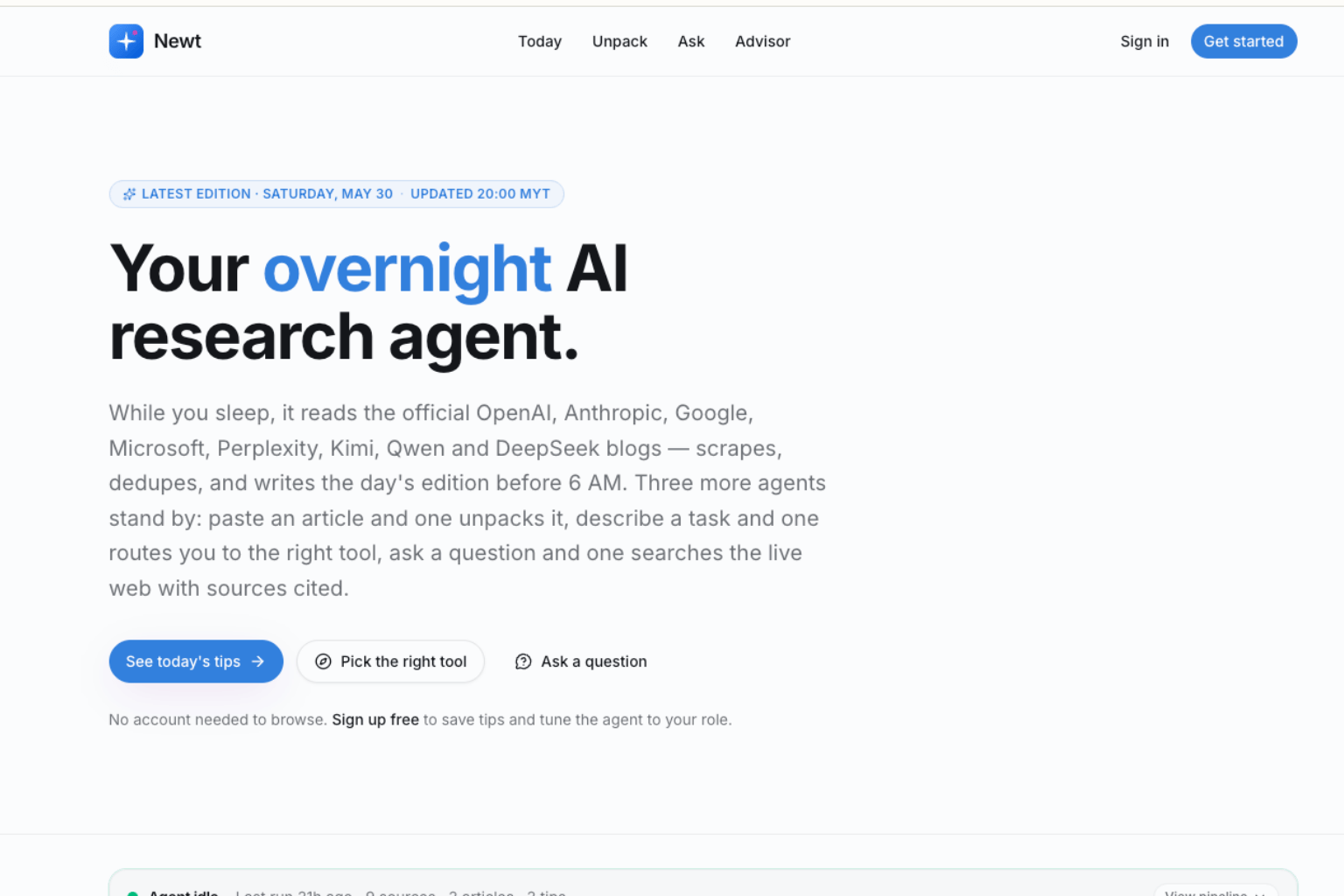
It is a reflection on building Newt, an overnight AI research agent that tries to turn noisy AI updates into practical, role-based work tips.
The question I wanted to test was simple:
Can AI help people move from “I saw another AI update” to “I know how to use this at work today”?
---
Experiment Snapshot
| Field | Detail | |---|---| | Experiment | Newt — an overnight AI research agent | | Built with | v0, Vercel, Vercel AI Gateway, Firecrawl MCP, Tavily MCP, Supabase | | Problem tested | AI updates are everywhere, but most people are not sure how to apply them at work | | User benefit | Role-based AI tips, practical prompts, source links, and suggested next actions | | Status | Early prototype | | Main learning | AI agents are most useful when they help translate information into action |
---
Why I Built Newt
The idea came from something I keep noticing at work and in AI conversations.
Everyone wants to use AI.
Everyone wants to know whether AI actually saves time.
But everyone’s work is different.
A sales leader does not need the same prompt as a project manager.
A marketer does not need the same AI tip as an operations lead.
A beginner does not need the same learning path as someone already building agents.
Yet many AI updates still arrive in the same format:
- Here is the latest model.
- Here is a new tool.
- Here is a new feature.
- Here are 20 prompts you should try.
- Here is another “must-know” AI update.
Useful? Sometimes.
Overwhelming? Very often.
The problem is not that people lack AI information.
The problem is that most AI information is not translated into their work context.
That is the gap Newt is trying to explore.
---
The Experiment
Newt works like an overnight AI research agent.
While you sleep, it scans AI-related sources, extracts useful updates, removes duplicates, and turns them into practical work tips.
But I did not want Newt to become just another AI news feed.
There is already enough AI news.
The more useful question is:
What does this update mean for my work?
So each Newt tip tries to answer six practical questions:
- What changed?
- Why does it matter?
- How can I use this at work?
- How much time could this potentially save?
- What prompt can I try?
- Which source can I verify?
That last question matters.
In AI, speed is helpful.
But trust still matters.
If a tip cannot be verified, users should not blindly accept it.
---
From AI News to AI Use
The real value of AI is not just knowing what is new.
It is knowing what is useful.
For your role.
For your task.
For your confidence level.
For your preferred tools.
For your next action.
This is why I wanted Newt to have a personalisation layer.
Instead of giving everyone the same generic AI advice, Newt can help users learn based on:
- Their role
- Their task
- Their preferred tools
- Their level of AI confidence
- Their saved interests
- Their learning needs
Because AI adoption is not only a technology challenge.
It is also a behaviour change challenge.
People do not need to be told to “use AI more.”
They need to see where AI fits naturally into their actual work.
---
The Agents Inside Newt
Beyond the overnight research flow, I added a few simple on-demand agents.
1. Unpack
Unpack helps users paste an AI article and receive practical takeaways.
The goal is to help users move from reading an article to understanding what they can actually do with it.
It answers questions like:
- What is the article really saying?
- What matters for a working professional?
- What can I try from this?
- What should I ignore for now?
---
2. Advisor
Advisor helps users describe a task and receive a recommendation on which AI tool may be most suitable.
For example, a user might say:
I need to summarise a long report and turn it into talking points for my team meeting.
Advisor can then suggest the type of AI tool or workflow that may fit the task better.
The goal is not to push one specific tool.
The goal is to help users make a better decision.
---
3. Ask
Ask supports AI-related questions with web-grounded answers and sources.
This is useful because AI changes quickly.
A generic answer may not be enough.
Users need answers that are current, grounded, and verifiable.
---
The Stack Behind Newt
Newt was built using:
| Layer | Tool | |---|---| | Frontend and app build | v0 | | Deployment | Vercel | | AI model access | Vercel AI Gateway | | Article extraction | Firecrawl MCP | | Web search and grounding | Tavily MCP | | User preferences and saved libraries | Supabase |
This stack helped me move quickly from idea to working prototype.
But the bigger learning was not just technical.
The more important learning was product thinking.
The question was not only:
Can I connect these tools?
The better question was:
What useful job should this agent actually perform for the user?
---
What I Learned About AI Agents
Building Newt reminded me that AI agents are not only about automation.
It is easy to describe an agent as something that performs tasks:
- Scan sources
- Extract articles
- Summarise updates
- Remove duplicates
- Generate tips
- Save outputs
That is useful.
But if an agent only collects more information, it may simply create faster noise.
The more important design questions are:
- What should the agent pay attention to?
- What should it ignore?
- How should it decide what is useful?
- How should it explain relevance?
- How should it help the user take action?
That is where I think AI agents become more valuable.
Not just doing tasks faster.
But helping people decide what matters.
---
What Is Still Rough
Newt is still early.
Still rough in places.
Still learning.
Some areas I would improve next:
- Better onboarding by role and confidence level
- Clearer daily digest experience
- More practical prompt examples
- Better saved library structure
- More work-specific learning paths
- Stronger source ranking and verification
- A clearer way to track estimated time saved
- Better feedback loops from users
This is also why I see Newt as an experiment rather than a finished product.
The prototype works.
But the learning loop is still developing.
---
Why This Matters for Work
In many organisations, AI adoption is still measured by activity.
How many people attended training?
How many people tried a tool?
How many use cases were submitted?
How many prompts were shared?
These are useful signals.
But they are not enough.
A better set of questions may be:
- Did AI help someone complete a task faster?
- Did AI improve the quality of thinking?
- Did AI reduce rework?
- Did AI help someone make a better decision?
- Did AI help a team move with more clarity?
- Did AI make learning easier and less intimidating?
That is the space Newt is exploring.
Not AI for curiosity only.
AI for practical work improvement.
---
The Bigger Reflection
This hackathon reminded me that learning AI is not only about attending more sessions.
At some point, we need to build something.
Even if it is small.
Even if it breaks.
Even if it is rough.
Because building exposes the real questions.
It forces us to move from theory to practice.
It shows us where the assumptions are weak.
It reveals what users may actually need.
And it helps us understand the difference between a cool demo and a useful product.
For me, Newt became a small experiment in making AI learning more personal, practical, and work-ready.
The goal is not to help people chase every AI update.
The goal is to help people turn the right update into a useful next action.
From:
I saw another AI update.
To:
I know how to use this today.
That is the shift Newt is trying to support.
---
Try Newt
Newt is still an early prototype, but feedback would be helpful.
Try it here:
I would especially appreciate feedback on:
- What kind of AI tips would be useful for your role?
- Would role-based AI updates help you learn faster?
- What would make an overnight AI research agent genuinely useful for your work?
- How should time saved or value unlocked be measured?
Still early.
Still learning.
Still building.